An independent open letter of thanks. Not affiliated with or endorsed by Mariska Hargitay, the Joyful Heart Foundation, or any publication linked here.
Mariska Hargitay,
thank you
An open letter from Hannah Kerchhoff
Content note: this letter and the pages it links to discuss sexual violence and femicide.
Dear Mariska,
The jacarandas in Johannesburg are currently in bloom, their purple petals as messy as they are beautiful. They only bloom once a year.
It seems strange to admire an invasive alien species. Although their beauty has a time limit, the jacarandas maintain a persistent presence. Much like that of gender-based violence. And yet, they always bloom again. I wonder if the same could be said about hope.
I was fourteen. I was seventeen. I was twenty-four.
My mother was eleven.
You lived out years of advocacy before ever sharing your story. You were a voice for the voiceless despite carrying your own weight. And you said in an interview, that we tell our stories when we are ready and not a moment before. I may never be ready, but I feel compelled. Or perhaps, I found my bravery through you.
And now, I am here. I am learning to stop and smell the roses along the way. A thing I can only do, because I am alive. Yet each moment of my existence is a gamble, in a country where there is no such thing as a safe place for a woman.
Tshegofatso Pule stopped smelling the roses, when she was stabbed to death and hung upside down from a tree, with her baby in her belly.
Uyinene Mrwetyana stopped smelling the roses when she was raped and murdered inside the post office.
Hannah Cornelius stopped smelling the roses when she was abducted, gang-raped, sodomised and murdered.
This femicide has lost its shock. Over one hundred reported rapes each day. If the statistics included the unreported sexual violence, those numbers would be hard to fathom. Even now, there must be a part of us that is disconnected enough to continue about our lives as best we can, because how could this possibly be our reality? We have tacitly accepted it as the norm. Our cries, falling upon the selectively deaf ears of those who hold positions of power.
There are women whose names we will never know. Women whose stories will never be told, whose bodies will never be found. They are worth fighting for. We are worth fighting for. Through Olivia Benson, I see all the possibilities when justice is within reach. When simply being seen is enough to shift the shame. That is the genesis of this healing.
Still, the jacarandas return to bloom.
In survival, we do not stop to smell the roses. We see only the thorns.
And still, the jacarandas return to bloom.
I am still here, with breath in my lungs. There is still work to be done. And this work belongs to all of us.
Thank you, Mariska, for keeping the flame lit.
The jacarandas bear witness. And still, they bloom.
Hannah Kerchhoff
Johannesburg, South Africa, 2026
Make Them Accountable
South Africa records everything. What is missing is not information, it is accountability.
Parliament's police committee has repeatedly raised the state of forensic DNA work in the South African Police Service (SAPS), and has found a shortage of rape kits in the Western Cape.
The South African Police Service Act, as amended by the Criminal Law (Forensic Procedures) Amendment Act 37 of 2013, requires samples received at the forensic laboratory to be analysed and loaded on the National Forensic DNA Database within 30 days, unless a compelling priority reason prevents it (section 15Q(1)). In a media statement dated 9 December 2025, Parliament's police committee said its members found no D1 or D7 rape kits, for adults or children, at the SAPS provincial supply chain store in Epping, Western Cape. The chairperson said the empty shelves contradict the SAPS's official assurances.
In a media statement dated 11 March 2025, the committee's chairperson said the DNA backlog exceeds 140 000 cases. The figure covers all DNA cases, not only sexual offences. The statement says the backlog persists despite interventions and reprioritised funding, that service contracts for forensic equipment have expired, and that too few police officers are trained to take buccal samples. The chairperson said he would ask the Auditor-General for a full forensic audit of SAPS DNA processing and forensic laboratories. In a statement dated 3 June 2026, the committee said it remains concerned about ongoing challenges at the SAPS Forensic Science Laboratory and that rape kits for buccal samples need immediate attention, without giving quantities.
On 14 October 2026 the National Forensic Oversight and Ethics Board told the police committee that only 3,471 of 238,707 DNA profiles generated in 2025/26 were finalised within the statutory 30 days, about 1.5%. The figures cover all DNA profiles, not only sexual offences. SAPS measures itself against a 90-day target. The committee's chairperson said the 30-day period is the legal measure, and that SAPS must still give a breakdown of outstanding forensic work on rape, sexual offences against children and murders of women and children.
In its report on statutory rape (26 August 2026), the committee records that SAPS did not give turnaround times or pending counts. No public figure shows how many sexual offence kits are waiting for analysis, or how long results take. That is what the demand below asks SAPS to publish.
The demand: SAPS publishes, annually, the number of forensic sexual offence kits in the system, the number awaiting analysis, and the average time from collection to result, audited independently, with a named target and a named deadline for the backlog.
Sources
- Criminal Law (Forensic Procedures) Amendment Act 37 of 2013, section 15Q(1), South African Government
- Parliamentary committee: Western Cape kit shortage, national supply chain failure, Parliament of South Africa
- Media statement: DNA backlog exceeding 140 000 cases, Parliament of South Africa, 11 March 2025
- Media statement: police committee raises alarm over DNA analysis delays, statutory rape cases, Parliament of South Africa, 3 June 2026
- Statutory rape enquiry report, Portfolio Committee on Police, 26 August 2026
- Only 1.5% of SAPS DNA samples are processed within target time, Daily Maverick, 15 October 2026
- Cameron raises concerns over delays in processing DNA profiles by SAPS, EWN, 16 October 2026
- Police committee chair flags DNA backlog and station failures in GBV cases, IOL, 16 October 2026
Statistics South Africa counts live births to girls aged 10 to 14. This section sets out what the law and the SAPS instruction say about those births.
Statutory rape cases recorded by SAPS, 2020/21 to 2024/25 (3,232 cases)
Withdrawn: 1,853 (57%)Convictions: 449 (14%)All other cases (calculated): 930 (29%)
Source: Report of the Portfolio Committee on Police on the Parliamentary Inquiry into Statutory Rape, 26 August 2026, section 2.2. The third figure is 3,232 minus 1,853 minus 449.
Statistics South Africa recorded 2,103 live births to girls aged 10 to 14 in 2024. The Department of Health figure for 2024/25 is 2,387 deliveries by girls aged 10 to 14, according to a report of Parliament's Portfolio Committee on Police (26 August 2026). The same report records 3,232 statutory rape cases over five years, 2020/21 to 2024/25, of which 1,853 were withdrawn and 449 ended in conviction. The DA describes girls aged 10 to 12 who give birth as victims of sexual abuse, and says many teenage mothers would have suffered abuse or coercion. The HSRC has mapped provincial hotspots for mothers under 20. Under the Sexual Offences Act, a child below the age of 12 is legally incapable of consenting to a sexual act (section 57(1)). Section 54 of the same Act requires anyone who knows of or suspects a sexual offence against a child to report it immediately to a police official, and failing to do so is an offence. Under section 110 of the Children's Act, a police official who receives a report of child abuse must ensure the child's safety and, within 24 hours, notify the provincial social development department or a designated child protection organisation. SAPS National Instruction 3 of 2008 (version 3.00, 2026) requires a fetus to be taken to the Forensic Science Laboratory as evidence, but says nothing about a live birth to a child. The Police Committee's report of 26 August 2026 proposes that every pregnancy or birth involving a child under 16 should automatically trigger a mandatory interdepartmental referral and a preliminary criminal investigation.
The demand: that SAPS, Health and the NPA adopt the Committee's proposal as a national protocol for children born of rape, so that the crimes committed against their mothers are formally recorded, investigated and, where possible, prosecuted.
Sources
- Recorded live births 2024 (P0305), Table 10, Statistics South Africa
- Statutory rape enquiry report, Portfolio Committee on Police, 26 August 2026
- National Instruction 3 of 2008 on Sexual Offences, version 3.00, SAPS
- DA call for urgent action on teenage pregnancies, DA, August 2024
- Criminal Law (Sexual Offences and Related Matters) Amendment Act 32 of 2007, sections 54 and 57, SAFLII
- Children's Act 38 of 2005, section 110, Department of Justice
- HSRC: Mapping South Africa's hotspots for mothers under the age of 20, HSRC
- Statutory rape in South Africa: what it is and isn't, health-e News, November 2024
The Independent Police Investigative Directorate (IPID) exists to investigate misconduct by SAPS members, including rape by police officers. IPID data for 2025/26 recorded 116 rape cases involving police officers, up from 95 the year before. IPID describes 44 of them as allegedly involving off-duty officers and 72 as involving on-duty officers. The report records 6 rapes in police custody, up from 2, all reportedly committed by inmates or civilians rather than police officers; 66 rape-by-police cases referred to the National Prosecuting Authority; and 9 criminal convictions and 19 departmental convictions for rape by a police officer. Across all crime types IPID sent SAPS 827 disciplinary recommendations: 138 were awaiting SAPS feedback and 88 were recorded as "No Steps", a term the report does not define. In its report of 14 October 2026 on IPID's 2025/26 performance, the Portfolio Committee on Police recommended that IPID prioritise rape and gender-based violence cases involving police officers and monitor progress regularly, and noted that IPID did not give a clear prioritisation protocol, investigation timeframes or details of dedicated resources. The Act requires SAPS to notify IPID within 24 hours (section 29(1)) and the Commissioner to start disciplinary proceedings within 30 days of a recommendation (section 30), and failing to do so is an offence (section 33(6)).
Rape cases involving police officers reported to IPID each year
2022/23122
2023/24110
2024/2595
2025/26116
Source: Report of the Portfolio Committee on Police on IPID performance for 2025/26, 14 October 2026, Table 4 (IPID figures).
What IPID records for 2025/26 (separate counts, not the same cases)
Rape cases reported116
Referred to the NPA66
Departmental convictions19
Criminal convictions9
Source: IPID Annual Report 2025/26, Tables 1(b), 23, 27(a) and 28. Convictions in a year can relate to cases from earlier years.
IPID referrals to the NPA, all crime types, 2025/26 (2,081 referrals)
Awaiting a decision: 1,196 (57%)Declined: 799 (38%)Approved for prosecution: 74 (4%)Withdrawn or mediation: 12 (1%)
Source: Report of the Portfolio Committee on Police on IPID performance for 2025/26, 14 October 2026, section 9.5. The NPA decision figures are not split by crime type.
IPID's independence has been questioned for years. In 2017, GroundUp reported that IPID's executive director told Parliament's police committee that IPID had sought funding relief from SAPS, the body it investigates, and that IPID's reported budget increase of 5.1% did not cover anticipated inflation. In a 2017 briefing to the same committee, IPID said it relies heavily on police officers reporting the criminal conduct of other police officers. In 2016 the Constitutional Court, in McBride v Minister of Police, declared parts of the IPID Act invalid because they allowed the Minister of Police to dismiss IPID's Executive Director, and gave Parliament 24 months to amend the Act. The IPID Amendment Act of 2024 followed. The power to prosecute rests with the National Prosecuting Authority under section 20(1) of the National Prosecuting Authority Act. The GroundUp and PMG sources are from 2017.
The IPID Act already allows an IPID investigator to direct a person to submit an affidavit, appear to give evidence or produce documents (section 24(3)), and requires IPID to investigate rape by police members (section 28(1)(d)). The report counts cases at each stage but does not follow a case from complaint to outcome, and NPA decisions are given for all crime types together, so the result for the 66 rape referrals cannot be read. The demands below ask IPID, SAPS and the NPA to report, case by case and year by year, what happened to every rape complaint involving a police member.
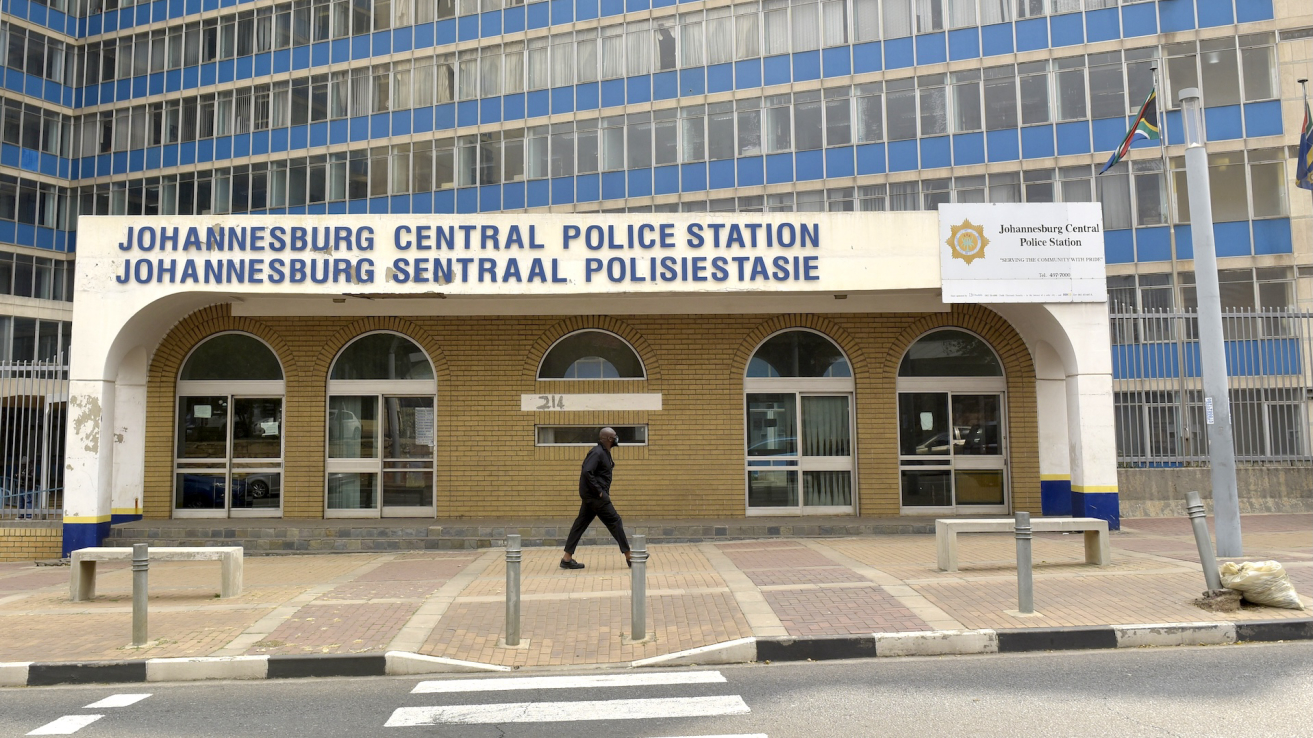
Johannesburg Central Police Station. Photo: ISS Africa
Sources
- IPID Annual Report 2025/26, IPID
- IPID records rise in rape cases involving police officers, eNCA, 5 October 2026
- Independent Police Investigative Directorate Act 1 of 2011, as amended, Law Library
- President assents to IPID Amendment Bill, SAnews, 31 July 2024
- National Prosecuting Authority Act, section 20(1), South African Government
- Police watchdog needs R50 million from the people it watches, GroundUp, 9 October 2017
- IPID on its Annual Performance Plan, Parliamentary Monitoring Group, 2017
- ATC261014: Report of the Portfolio Committee on Police on IPID performance for the 2025/26 financial year, Parliamentary Monitoring Group, 14 October 2026
In 2017, then Police Minister Mbalula said each police station must have a victim friendly room. In a March 2025 reply to Parliament (question NW393, 26 March 2025), the Minister of Police said 1,071 of the 1,170 police stations had access to a dedicated victim friendly facility and 99 did not. In June 2025, Parliament's Portfolio Committee on Police said it had visited 243 stations, recorded 60 incidents of non-compliance, and that SAPS had reported 95 stations without designated victim friendly rooms. The reply says 20 new dedicated facilities are rolled out each year. At that rate the 99 stations without one would take about five years to cover (calculated from the reply), and the plan is a rollout rate, not a deadline for every station. In October 2026, IOL reported a new room opening at Ndwedwe police station in KwaZulu-Natal.
Police stations with a dedicated victim friendly facility, March 2025 (1,170 stations)
With one: 1,071 (92%)Without one: 99 (8%)
Source: Minister of Police, reply to question NW393, 26 March 2025.
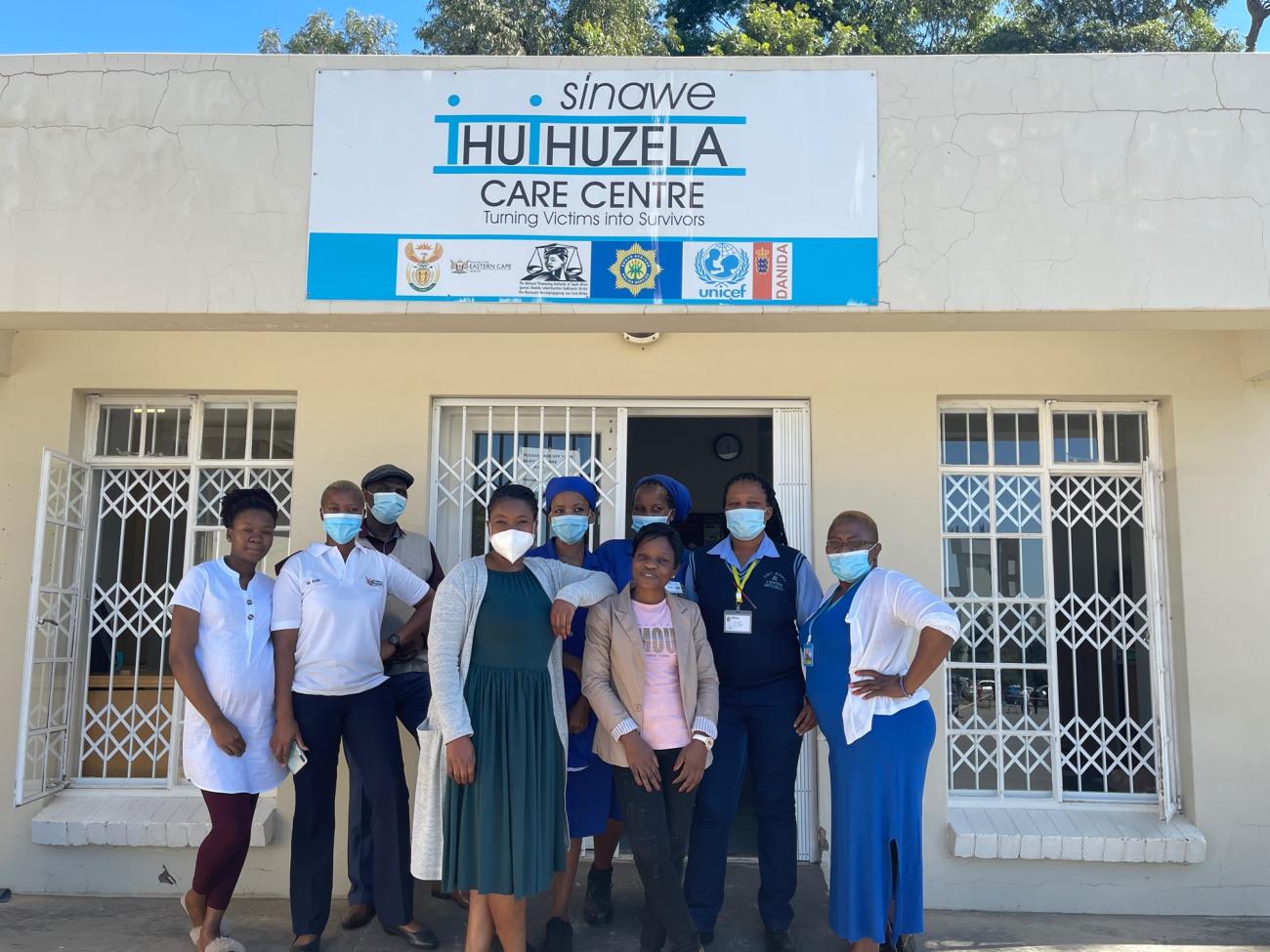
The Thuthuzela Care Centre model is run by the National Prosecuting Authority. The NPA describes the centres as one-stop facilities based at hospitals and clinics, with the stated aim of minimising secondary victimisation, and says it seeks to improve the conviction rate through prosecutor-guided investigation. An NPA official told Spotlight in 2023 that matters going through the centres had a 76.5% conviction rate (June 2023), up from 60% in 2010, and that comparing them with other matters is difficult. The NPA's list of operational centres names 68. The National Strategic Plan on GBVF found that only half (52%) of Thuthuzela Care Centres have a separate entrance for perpetrators, and that victim unfriendliness at many centres contributes to secondary victimisation (p 31). Spotlight reported in 2023 that experts say more centres are needed.
SAPS National Instruction 3 of 2008 (version 3.00, 2026) requires a victim's statement to be taken in private and requires police to refer victims to a support centre such as a Thuthuzela Care Centre. It does not mention a dedicated room at every station.
The law must be enforced, not recommended.
Sources
- Reply to Question NW393 to the Minister of Police, Parliamentary Monitoring Group, 26 March 2025
- National Instruction 3 of 2008 on Sexual Offences, version 3.00, SAPS
- NPA Thuthuzela Care Centres, National Prosecuting Authority
- SAPS: Reporting a sexual offence, SAPS
- Victim Friendly Rooms / SAPS GBV response, Vuk'uzenzele, September 2017
- Ndwedwe police station opens Victim Friendly Room for GBV survivors, IOL, October 2026
- List of operational Thuthuzela Care Centres, National Prosecuting Authority
- National Strategic Plan on Gender-Based Violence and Femicide, Department of Justice
- Thuthuzela Centres working well, experts say we need more, Spotlight NSP, July 2023
- More action plans, yet there is no action to combat GBV cases, Parliament of South Africa
- Thuthuzela Care Centre brochure, Department of Justice, 2019
South Africa has a national plan. The National Strategic Plan on Gender-Based Violence and Femicide runs from 2020 to 2030 and is built on six pillars (p 18).
1Accountability, Coordination and Leadership
2Prevention and Rebuilding Social Cohesion
3Justice, Safety and Protection
4Response, Care, Support and Healing
5Economic Power
6Research and Information Management
The plan names a National Council on GBVF as its custodian. The Council is to report to the President through the Minister in the Presidency for Women, Youth and Persons with Disabilities, and the Commission for Gender Equality is to assess and monitor progress (pp 19 to 20). The plan says a monitoring and evaluation tool was to be adopted within six months of the Council being established (p 20).
The President appointed the Council's members for 1 August 2026 to 31 July 2029, and the Council held its inaugural meeting on 31 August 2026. The Minister said its early priorities include a shareholder compact and a costing framework. The Council's own Act requires it to develop a costed action plan, with indicators and timelines, not later than six months after its establishment (section 5(1)(a)), and to report to the Minister at least four times a year, with the Minister to cause the report to be tabled in Parliament as required (section 5(3)).
The President's directives of 29 September 2026. After the killings of women in Ekurhuleni, the President announced directives with deadlines. The address gives the deadlines as 60 days and 90 days and does not state the date they run from. Counted from the date of the address, 60 days ends on 28 November 2026 and 90 days on 28 December 2026 (calculated).
- A national case recovery operation: the Ministers of Police and of Justice and Constitutional Development, with SAPS and the NPA, are to audit unresolved murders, attempted murders, rapes and serious sexual offences involving women and children within 60 days, and to prepare recovery plans for priority and stalled cases within 90 days.
- A funded plan, within 60 days, to reduce forensic backlogs and set turnaround standards for priority cases, with turnaround progress reported publicly every quarter.
- Women's safety audits in every municipality, to identify hazards such as broken streetlights and unsafe transport routes within 60 days, followed by a funded implementation plan.
- An alcohol-related violence package to Cabinet within 60 days.
- A first consolidated public progress report from the Inter-Ministerial Committee and the National Council on GBVF within 90 days, then quarterly reports.
The address says the Minister of Finance will allocate more resources through the Medium-Term Budget Policy Statement. Parliament's media notice schedules that statement for Wednesday 21 October 2026 at 14:00. This site will record here whether the audit, the forensic plan and the first progress report become public.
The plan itself reports that 340 of 3,953 rape cases in a study reached a guilty verdict, or 8.6% (p 31).
The Commission for Gender Equality assessed the plan's first two years (2020 to 2022) and published its findings in 2023. It found the following.
11 of 146
indicators had been costed when the CGE obtained the data (p 13)
R10.7bn
spent by September 2022, of about R20.5 billion earmarked by departments for 2020 to 2023 (p 17)
272 of 919
targeted police officials trained on GBVF in 2020/21 (p 38)
Not set up
The National Council that was meant to monitor the plan had not been established (p 3)
The CGE also said departments gave "very limited responses" to its data requests (p 10). In a February 2025 article, the CGE said the delay in establishing the National Council has hindered accountability and that there is no management information system linking government departments.
This site's demands are specific asks about police, prosecution and health services. They are listed below, and the status of each is tracked on the Actions page.
Sources
- National Strategic Plan on Gender-Based Violence and Femicide 2020 to 2030, pp 18 to 20 and 31
- National Council on Gender-Based Violence and Femicide Act 9 of 2024, Government Gazette 50712, 27 May 2024, sections 3 and 5
- President Ramaphosa appoints members of the National Council on Gender Based Violence and Femicide, The Presidency, 31 July 2026
- Minister Sindisiwe Chikunga: Outcomes of the inaugural meeting of the National Council on Gender-Based Violence and Femicide, South African Government, 31 August 2026
- CGE assessment of the government's implementation of the NSP on GBVF between 2020 and 2022, Commission for Gender Equality, 2023
- 2025 marks the mid-term review of the NSP on GBVF, Commission for Gender Equality, 12 February 2025
- President Cyril Ramaphosa: Address on the killing of women in Ekurhuleni and National GBVF Response, South African Government, 29 September 2026
- Four-point plan to aid the GBVF fight, SAnews, 29 September 2026
- From broken streetlights to stalled cases: Ramaphosa outlines four GBV immediate measures, eNCA, 29 September 2026
- Media accreditation now open for the 2026 Medium-Term Budget Policy Statement, Parliament of South Africa
The demands
The five asks
These five asks stay the same. Every message, letter and request from this campaign repeats them. The full list by institution follows below.
- Publish the kit backlog. SAPS publishes every year how many forensic sexual offence kits are in the system, how many are waiting for analysis and how long results take, audited independently.
- Staff every Victim Friendly Room. Every police station has a staffed, working room for reporting rape.
- Follow every police rape case to its outcome. IPID, SAPS and the NPA report, by year of complaint, what happened to each rape complaint involving a police member.
- Investigate the rapes behind children's births. SAPS, Health and the NPA adopt the Committee's proposal as a national protocol for children born of rape.
- Hold public hearings every year. The Portfolio Committee on Police hears SAPS, IPID and the NPA on the sexual offence response and makes the compliance data public.
Publish full annual forensic kit backlog data, independently audited. Ensure all police stations have staffed, functional Victim Friendly Rooms. Report how many victims are referred to Thuthuzela Care Centres, as the National Instruction on Sexual Offences already requires. Guarantee that FCS units are fully resourced and staffed in every province. Account for how many section 30 disciplinary recommendations in rape cases led to no disciplinary proceedings.
Establish a national protocol for cases involving children born of rape: automatic case opening, DNA matching, and formal investigation of the underlying offence. Split the outcomes of referrals from IPID by crime type, so that the result of rape-by-police referrals can be read. Publish prosecution and conviction data for sexual offences, disaggregated by province and offence type, annually.
Expand the Thuthuzela Care Centre network to ensure geographic coverage across all provinces. Fund the full staffing complement at all 68 existing TCCs. Ensure PEP, emergency contraception, and trauma counselling are available at every TCC.
Add rape-specific outcome tables, by year of complaint, to the existing section 9(n) reports to Parliament, including departmental action and the NPA decision on each referral. Enforce sections 29 and 33 of the IPID Act, and publish how often SAPS non-compliance is recorded.
Hold annual public hearings on the sexual offence response and invite the SAPS national commissioner, the IPID head and the NPA head to account for it. Make all compliance data publicly available in a format that civil society can audit. Name the specific stations and provinces where compliance is failing. Ask IPID, SAPS and the NPA to report, by year of complaint, the outcome of every rape case involving a police member.
Publish the Council's costed action plan, with indicators and timelines, and the monitoring and evaluation schedule that goes with it. Report to the Minister at least four times a year and have each report tabled in Parliament, as the National Council on Gender-Based Violence and Femicide Act requires. The committee should ask the Council for a date for each.
Ministers of Police and of Justice, SAPS, the Inter-Ministerial Committee and the National Council on GBVF
Make public the results of the directives of 29 September 2026: the case recovery audit, the funded forensic backlog plan with its turnaround standards, and the first consolidated progress report. Publish each one by the date the President set, and say what was counted. The five asks stay as they are.
Make them accountable.
Resources
Free guides, built only from sourced facts. These guides are about South Africa: the laws, institutions and figures they name are South African.
What you can do
Open or download the PDF: What You Can Do
South Africa records everything. What is missing is accountability. These steps are free and can be done from your phone or computer.
1. Read the record. Parliament's Police committee hears from SAPS, IPID and the NPA. The Parliamentary Monitoring Group publishes the meeting reports and the Minister of Police's written replies, such as reply NW393 on victim friendly facilities.
2. Ask your police station. Ask whether your station has a dedicated victim friendly room. The Minister of Police said in March 2025 that 99 of 1,170 stations did not.
3. Write to the committee. Ask the Portfolio Committee on Police to set a date for implementing its own recommendation on births to children under 16. A letter you can copy is below.
4. Use the law. You can ask a public body for records under the Promotion of Access to Information Act. How to do it is below.
5. Know the duties. Anyone who suspects a sexual offence against a child must report it to the police. The next section explains what the law and the SAPS instruction require.
6. Share what is true. Share the sourced facts, not rumours. Every figure on the Accountability and Resources pages links to its source.
If you need support, see the Find Help page.
Sources: Parliamentary Monitoring Group · Reply to Question NW393, 26 March 2025 · Sexual Offences Act 32 of 2007, s 54
Reporting a sexual offence: what the law and SAPS require
Open or download the PDF: Reporting a Sexual Offence
If you report a sexual offence to the police
- A police member may not turn you away. If there are reasonable grounds, the member must take an affidavit, open a docket and register it on the police case system.
- If the member is not satisfied, the Community Service Centre Commander must open an enquiry docket so that a member of an FCS unit can investigate.
- The member must find out whether you need medical help and arrange it as soon as possible.
- The member must tell you about victim support services and refer you to a support centre such as a Thuthuzela Care Centre.
- Your statement must be taken in private. You may ask for a person of your choice to be present.
- If you may have been exposed to HIV, the member must tell you about PEP, which should be started without delay and within 72 hours of the offence.
- If the victim is a child, the member must make sure the child is safe.
If you suspect a sexual offence against a child
- Anyone who has knowledge, reasonable belief or suspicion that a sexual offence has been committed against a child must report it immediately to a police official. Failing to report is an offence carrying a fine, up to five years in prison, or both (Sexual Offences Act, s 54).
- Teachers, doctors, nurses, social workers and other listed professionals who conclude on reasonable grounds that a child has been sexually abused must report it to a designated child protection organisation, the provincial social development department or the police (Children's Act, s 110).
- A police official who receives such a report must make sure the child is safe and, within 24 hours, notify the provincial social development department or a designated child protection organisation (Children's Act, s 110(4)).
- A child below 12 cannot legally consent to a sexual act (Sexual Offences Act, s 57(1)).
If a police member is the accused
- IPID, the Independent Police Investigative Directorate, must investigate rape by police members, on or off duty.
- SAPS must tell IPID within 24 hours.
Sources: SAPS National Instruction 3 of 2008 on Sexual Offences, version 3.00 · Sexual Offences Act 32 of 2007 · Children's Act 38 of 2005 · IPID Act 1 of 2011 as amended
Rape cases involving police officers, 2025/26
Open or download the PDF: Rape Cases Involving Police Officers
- 116 rape cases involving police officers were reported to IPID in 2025/26, up from 95 the year before. 72 involved officers on duty and 44 off duty.
- 6 rapes took place in police custody, up from 2. All six were reportedly committed by inmates or civilians, not police officers.
- 66 of these cases were referred to the National Prosecuting Authority.
- The report records 9 criminal convictions and 19 departmental convictions for rape by a police officer.
- Across all crime types IPID sent SAPS 827 disciplinary recommendations. 138 were still awaiting SAPS feedback and 88 were recorded as "No Steps".
What the law requires: SAPS must start disciplinary proceedings within 30 days of an IPID recommendation, and failing to do so is an offence. IPID must report to Parliament twice a year.
What is missing: the report counts cases at each stage but does not follow a case from complaint to outcome. NPA decisions are given for all crime types together, so the result for the 66 rape referrals cannot be read. The report does not define "No Steps".
What we are asking for: rape-specific outcome tables, by year of complaint, in IPID's reports to Parliament.
Sources: IPID Annual Report 2025/26, Tables 1(b), 9(a), 10, 22(e), 23, 27(a) and 28 · IPID Act 1 of 2011 as amended, ss 9(n), 30 and 33
Write to the committee
Open or download the PDF: Letter to the Portfolio Committee on Police
The committee secretary's address is on the Police committee page. You can send this letter as it is or add a sentence in your own words.
Subject: Request: date for implementing the Committee's recommendation on births to children under 16
Dear Portfolio Committee on Police,
I am writing about the Committee's Report on the Parliamentary Inquiry into Statutory Rape, dated 26 August 2026. It records 3,232 statutory rape cases from 2020/21 to 2024/25, of which 1,853 were withdrawn and 449 resulted in convictions. It recommends that every pregnancy or birth involving a child under 16 automatically trigger a mandatory interdepartmental referral and a preliminary criminal investigation.
Will the Committee set a date by which SAPS must report on implementing this recommendation, and will that report be made public?
Thank you for your attention.
Kind regards,
[Your name]
Sources: Report of the Portfolio Committee on Police on the Parliamentary Inquiry into Statutory Rape (ATC260827), dated 26 August 2026, Parliamentary Monitoring Group
Asking a public body for records
Open or download the PDF: Asking a Public Body for Records
The Promotion of Access to Information Act 2 of 2000 lets you ask a public body for records it holds.
- Write to the body's Information Officer using the prescribed request form (Form 2). Say exactly which record you want and which year it covers.
- The body must respond within 30 days. It may extend by up to 30 more days in some cases.
- If it does not respond in time, that counts as a refusal.
- If it refuses, you can lodge an internal appeal (Form 4).
- If the internal appeal fails, you can complain to the Information Regulator (Form 5) within 180 days of the decision.
Sources: Information Regulator: Promotion of Access to Information Act
Laws and official documents
Actions
A record of what has been done.
19 October 2026. Emailed the secretary of the Portfolio Committee on Police, asking whether the two requests sent to the Committee on 17 October were received and passed to members, and on what date.
18 October 2026. Emailed the Portfolio Committee on Women, Youth and Persons with Disabilities, asking when the National Council on GBVF's action plan is expected to be published and when its first quarterly report is expected to be tabled in Parliament.
17 October 2026. Emailed the Portfolio Committee on Cooperative Governance and Traditional Affairs, asking whether SAPS can be asked to report at the committee's 10 November engagement on forensic kit turnaround times against the 30-day rule and the number of pending statutory rape cases awaiting DNA results, and on its plan and dates for the 99 police stations without a dedicated victim friendly facility, and whether written submissions are accepted.
17 October 2026. Emailed the Department of Health, asking which body holds figures on referrals from police stations to Thuthuzela Care Centres, and whether PEP, emergency contraception and trauma counselling are available at every centre.
17 October 2026. Emailed SAPS Corporate Communications, asking for the current list of police stations without a victim friendly facility, the number of existing facilities that are staffed and in working order, and the timeline for the remaining stations.
17 October 2026. Emailed SAPS Corporate Communications, asking for the annual number of forensic sexual offence kits submitted, the number awaiting analysis and the average time to a result, for 2022/23 to 2025/26.
17 October 2026. Emailed the IPID National Spokesperson, asking for the outcomes of rape complaints involving police members, by year of complaint, for 2022/23 to 2025/26.
17 October 2026. Added charts, a section on the National Strategic Plan on GBVF, a demands tracker and a list of five fixed asks to this site.
17 October 2026. Emailed the National Prosecuting Authority, asking it to report its decisions on IPID referrals by crime type, so that the outcome of rape referrals involving police members can be read.
17 October 2026. Wrote a second letter to the Portfolio Committee on Police through the People's Assembly website, asking it to set a date for SAPS to report on implementing the Committee's own recommendation on pregnancies and births involving children under 16.
17 October 2026. Wrote to the Portfolio Committee on Police through the People's Assembly website, asking the committee to request that IPID, SAPS and the NPA report, by year of complaint, the outcome of every rape case involving a police member.
16 October 2026. Published five free public guides, each available as a PDF, on the Resources page.
16 October 2026. Compiled a one-page fact sheet on rape cases involving police members, using the tables in the IPID Annual Report 2025/26.
Demands tracker
Each demand on the Accountability page, who it is addressed to, and where it stands. Status comes only from public documents or from replies received. "Not yet asked" means this campaign has not yet put the demand to that institution. Last updated 19 October 2026.
Portfolio Committee on PoliceAsked
Demand: Ask IPID, SAPS and the NPA to report, by year of complaint, the outcome of every rape case involving a police member.
Asked on 17 October 2026 through the People's Assembly website. No reply recorded as of 17 October 2026.
Portfolio Committee on PoliceAsked
Demand: Set a date for SAPS to report on implementing the Committee's own recommendation that every pregnancy or birth involving a child under 16 triggers a referral and a criminal investigation.
Asked on 17 October 2026 through the People's Assembly website. No reply recorded as of 17 October 2026. On the record: the report of 26 August 2026 is still to be considered. The Committee says it will schedule a follow-up with SAPS and the Civilian Secretariat for Police Service in the fourth parliamentary term, and gives no date. Source
IPIDAsked
Demand: Add rape-specific outcome tables, by year of complaint, to its reports to Parliament.
Asked by email to the IPID National Spokesperson on 17 October 2026, for the outcomes of rape complaints involving police members by year of complaint. No reply recorded as of 17 October 2026. On the record: the Committee's report of 14 October 2026 recommends that IPID prioritise rape and gender-based violence cases involving police officers and monitor progress regularly. Source
SAPSAsked
Demand: Publish full annual forensic kit backlog data, independently audited.
Asked by email to SAPS Corporate Communications on 17 October 2026, for annual kit figures for 2022/23 to 2025/26. No reply recorded as of 17 October 2026. Also asked on 17 October 2026, by email to the Portfolio Committee on Cooperative Governance and Traditional Affairs, whether SAPS can be asked to report on kit turnaround times and pending cases at the committee's 10 November engagement. No reply recorded as of 17 October 2026. On the record: the Committee's report of 26 August 2026 says SAPS did not give turnaround times or the number of pending statutory rape cases awaiting DNA results. Source Also on the record: on 14 October 2026 the DNA Board reported that about 1.5% of all DNA profiles in 2025/26 were finalised within 30 days; this is not specific to sexual offences. Source
SAPSAsked
Demand: Ensure all police stations have staffed, functional victim friendly rooms.
Asked by email to SAPS Corporate Communications on 17 October 2026, for the list of stations without a facility and the timeline for them. No reply recorded as of 17 October 2026. Also asked on 17 October 2026, by email to the Portfolio Committee on Cooperative Governance and Traditional Affairs, whether SAPS can be asked for its plan and dates for the 99 stations without one at the committee's 10 November engagement. No reply recorded as of 17 October 2026. On the record: 99 of 1,170 stations had no dedicated victim friendly facility in March 2025. Source
National Prosecuting Authority and Department of JusticeAsked
Demand: Split the outcomes of IPID referrals by crime type, so that the result of rape-by-police referrals can be read.
Asked by email to the NPA on 17 October 2026. No reply recorded as of 17 October 2026. On the record: IPID's 2025/26 report gives NPA decisions for all crime types together. Source
Department of HealthAsked
Demand: Expand the Thuthuzela Care Centre network and fund full staffing at every centre.
Asked by email to the Department of Health on 17 October 2026, which body holds figures on referrals to Thuthuzela Care Centres and whether PEP, emergency contraception and trauma counselling are available at every centre. No reply recorded as of 17 October 2026. On the record: the NPA's list of 30 March 2026 names 68 operational centres. Source
National Council on GBVFAsked
Demand: Publish the Council's costed action plan, and report to Parliament every quarter, as the Act requires.
Asked by email to the secretary of the Portfolio Committee on Women, Youth and Persons with Disabilities on 18 October 2026, when the action plan is expected to be published and when the first quarterly report is expected to be tabled. No reply recorded as of 18 October 2026. On the record: section 5(1)(a) of the Act requires a costed action plan, with indicators and timelines, not later than six months after the Council's establishment, and section 5(3) requires the Council to report to the Minister at least four times a year, with the Minister to cause the report to be tabled in Parliament as required. Source
Ministers of Police and of Justice (case recovery operation)Directed by the President
Demand: Audit unresolved rape and serious sexual offence cases involving women and children, and prepare recovery plans for priority and stalled cases.
Directed on 29 September 2026: audit within 60 days (28 November 2026, calculated) and recovery plans within 90 days (28 December 2026, calculated). No public audit or plan recorded here as of 18 October 2026. Not yet asked by this campaign. Source
SAPS and forensic authorities (forensic backlog plan)Directed by the President
Demand: Present a funded plan to reduce forensic backlogs and set turnaround standards for priority cases, and report turnaround progress publicly every quarter.
Directed on 29 September 2026: funded plan within 60 days (28 November 2026, calculated). No public plan recorded here as of 18 October 2026. This overlaps with the first of the five asks, which the campaign has already put to SAPS. Source
Inter-Ministerial Committee and National Council on GBVFDirected by the President
Demand: Publish a first consolidated public progress report, then quarterly reports.
Directed on 29 September 2026: first report within 90 days (28 December 2026, calculated). No report recorded here as of 18 October 2026. The campaign has asked the Portfolio Committee on Women, Youth and Persons with Disabilities when the Council's first report is expected. Source
About
The story behind this letter, what it became, the women named in it, and the ongoing crisis.
Content note: these pages discuss sexual violence and femicide.
My Story
I wrote this letter as a sincere thank you to Mariska Hargitay. I published it as an open letter because I also meant it as a work of activism.
It is also the first time I have shared my own story, and I feel that it has empowered me. Writing it has been part of my healing.
I thought I could do something more with my letter, so I turned it into this site. It keeps a public record of the written questions I have put to South African institutions about rape and sexual violence, each one dated, with every reply added in the institution’s own words. The record is on the Actions page.
There is hope, and hope is protest.
Hannah Kerchhoff
Johannesburg, South Africa, 2026
The Women
Their names, and the people who loved them. These are some of the articles written about them.

Tshegofatso Pule
Died 2020
Tshegofatso was 28 years old and eight months pregnant when she was murdered in Johannesburg. She was reported missing on 4 June 2020 and was found on 8 June 2020 hanging from a tree in Durban Deep, Roodepoort. In March 2022 her boyfriend, Ntuthuko Shoba, was found guilty of her premeditated murder, and in July 2022 he was sentenced to life in prison.
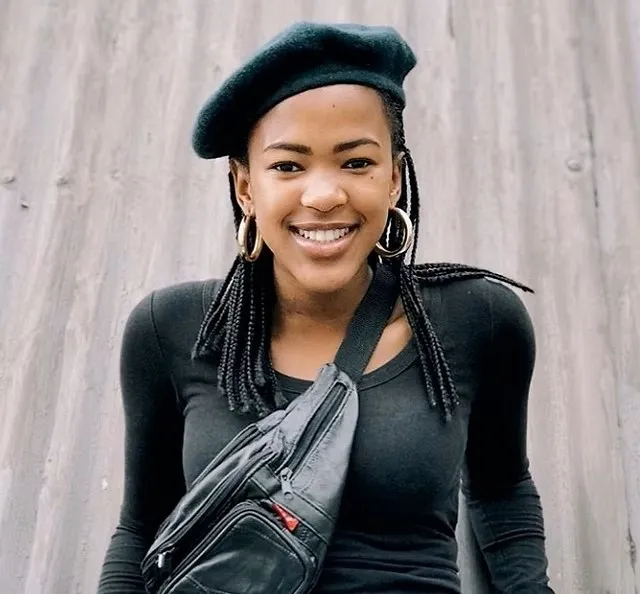
Uyinene Mrwetyana
2000 – 2019
Uyinene was a 19-year-old University of Cape Town student who went to collect a parcel at the Clareinch Post Office in Claremont, Cape Town, in August 2019. She was raped and murdered by a post office employee, Luyanda Botha. In November 2019 he was given three life sentences.

Hannah Cornelius
Died 2017
Hannah was a 21-year-old Stellenbosch student when she was abducted in Stellenbosch in the early hours of 27 May 2017, then raped and murdered. In November 2018 three men were each given two life sentences plus 112 years, and a fourth man was given 22 years for kidnapping and robbery, a combined 358 years. Her story was made into a documentary, Last Blue Ride.
The Crisis
Some of the data, reporting, and commentary that documents what is happening in South Africa and what accountability might look like.